English



WILDEN APPLICATION GUIDE
WILDEN Pumps for Water and Wastewater
Wastewater should be described by more than its solids percentage. Particle size, hardness, shape, settling tendency and the presence of fibres can change the selection. Distinguish a temporary dewatering duty from continuous sludge transfer before specifying pump size and maintenance access.

Typical transfer duty
Sump water, treatment streams and suitable sludge duties
Collection sump → Solids-aware transfer → Treatment stage
What to evaluate
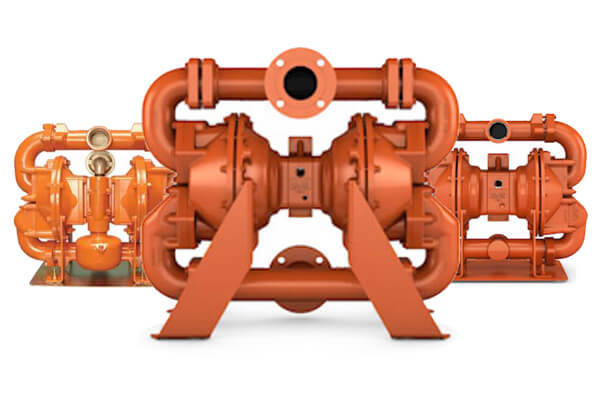
Evaluate an appropriate Pro-Flo SHIFT configuration for the actual medium. Where large solids are present, review dedicated Brahma designs instead of assuming a standard ball-check pump has the same passage capability.
Selection checklist
Document the largest particles and fibres
Check suction elevation at minimum liquid level
Provide access to inspect checks and wet-end components
Operating boundary
Do not apply a large-solids capability from one WILDEN family to every pump. Confirm the passage size and valve arrangement in the selected model documentation.
Maintenance and spare parts
Keep the complete WILDEN model code, installed diaphragm material and air distribution system in the maintenance record. Confirm air-kit and wet-kit compatibility separately. Follow the model-specific engineering, operation and maintenance manual for isolation, inspection, fastener torque and reassembly; a generic parts list is not a repair procedure.
Discuss your application
Send the fluid composition, concentration, temperature, viscosity, solids information, target flow, backpressure, suction conditions and available air supply. These details allow a meaningful configuration review and a matching spare-parts recommendation.
Explore WILDEN pumps · Repair kits · Request selection support
Editorial application guidance by Willee. Reference: Wilden Water and Wastewater. This page describes an application, not a customer installation or a guaranteed operating result.